
Question 8 explained:
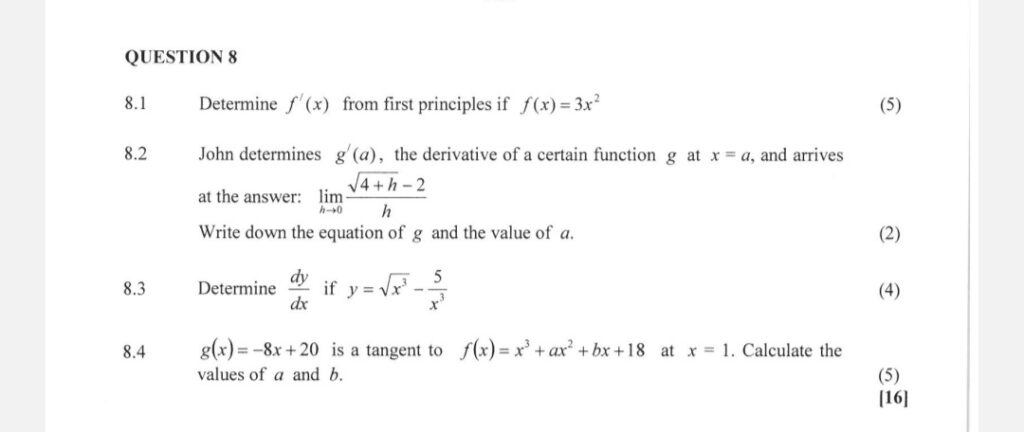
8.1
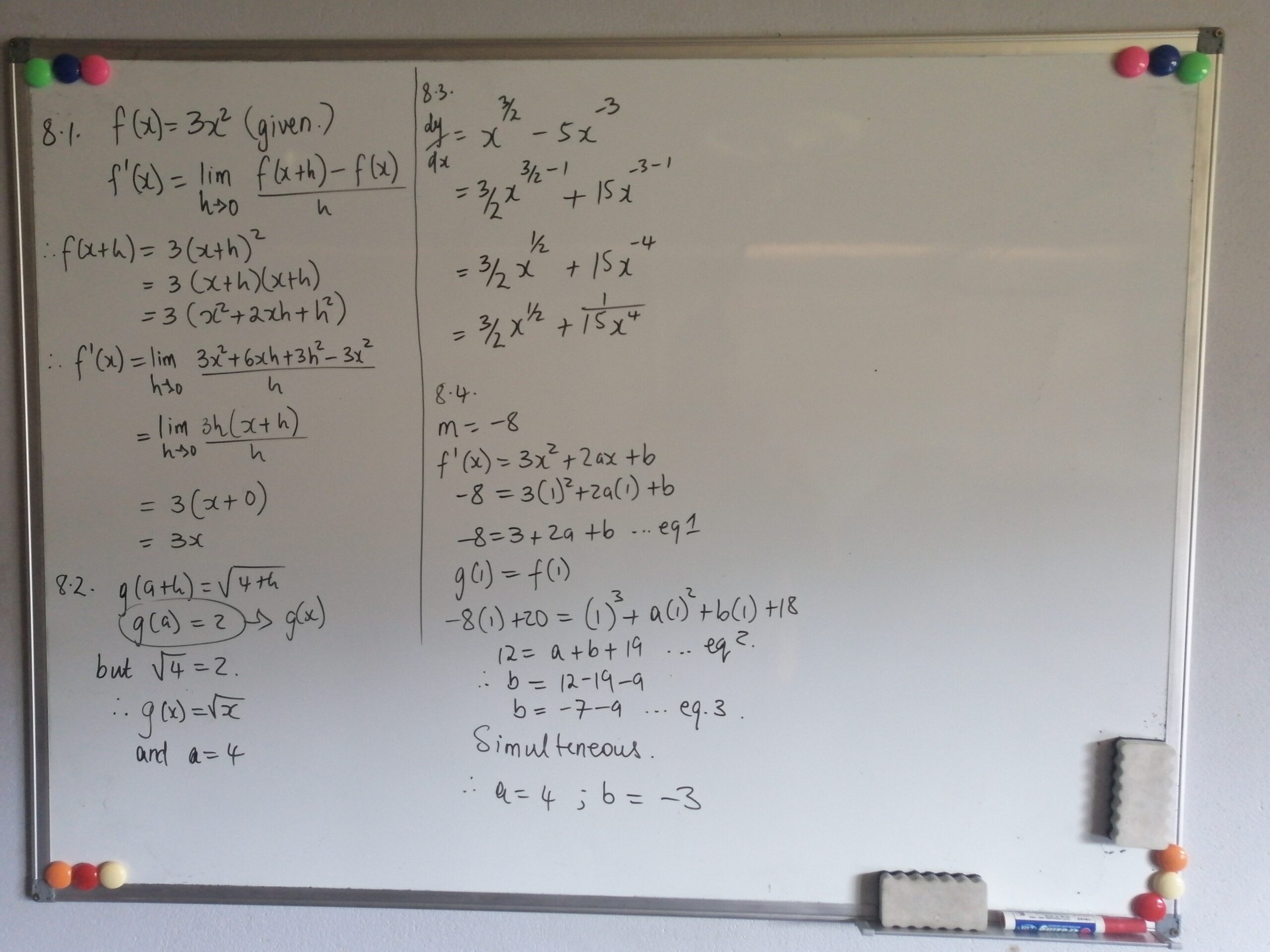
- derivative from first principles; here you want to get the marks, its basic algebra
- substitute (x+h) on the given f(x)
- substitute f(x+h) with the answer you get, and substitute f(x) with given equation
- simplify the numerator using algebraic rules
- factorise and divide h
- sub the remaining h with zero
8.2
- this is that type of question which separates the best from the rest, if you can’t get it, be happy to lose those marks
- from inspection:
- f(a)=2 f(a+h) = square root of 4+h
- 4 and 2 have square root relationship that we generally know, root of 4 is 2
- Which means f(x)=root of x, and a equal 4
8.3
- To use derivative from power rule, we have to change the square root and the fraction back to exponents
- Using the same old exponential rules from earlier grades
- Once you have exponents, drop the exponent to multiply the co-efficient of x
- And subtract 1 from the exponent, do this for each term of the equation
8.4
- The first derivative of a cubic function gives gradient at a point
- Gradient at stationary points is zero
- But here we are given gradient of tangent as -8, so equate that gradient to first derivate to get equation 1
- The tangent and the cubic graph intersect at x=1, equate the two equations and sub 1 on x to get equation 2
- Use simultaneous equations to solve for a and b
Solution:

General comment:
This is a fairly easy question and most learners get their marks, the trick is to know the following concepts:
- first derivative: gives gradient at any point of the cubic function
- tangent: equals the graph at a certain point, and its equation provides us with the gradient at that point
- power rule: drop the exponent to multiply the co-efficient of x And subtract 1 from the exponent, do this for each term of the equation. The constant falls away, this is the number without a coefficient
- exponents: a negative power can be written as 1 over that positive power, and vice versa.
- Surds: a root can be converted to an exponent, the exponent inside the root becomes numerator and the nth number of the root becomes the denominator (of the new exponent)