Question:
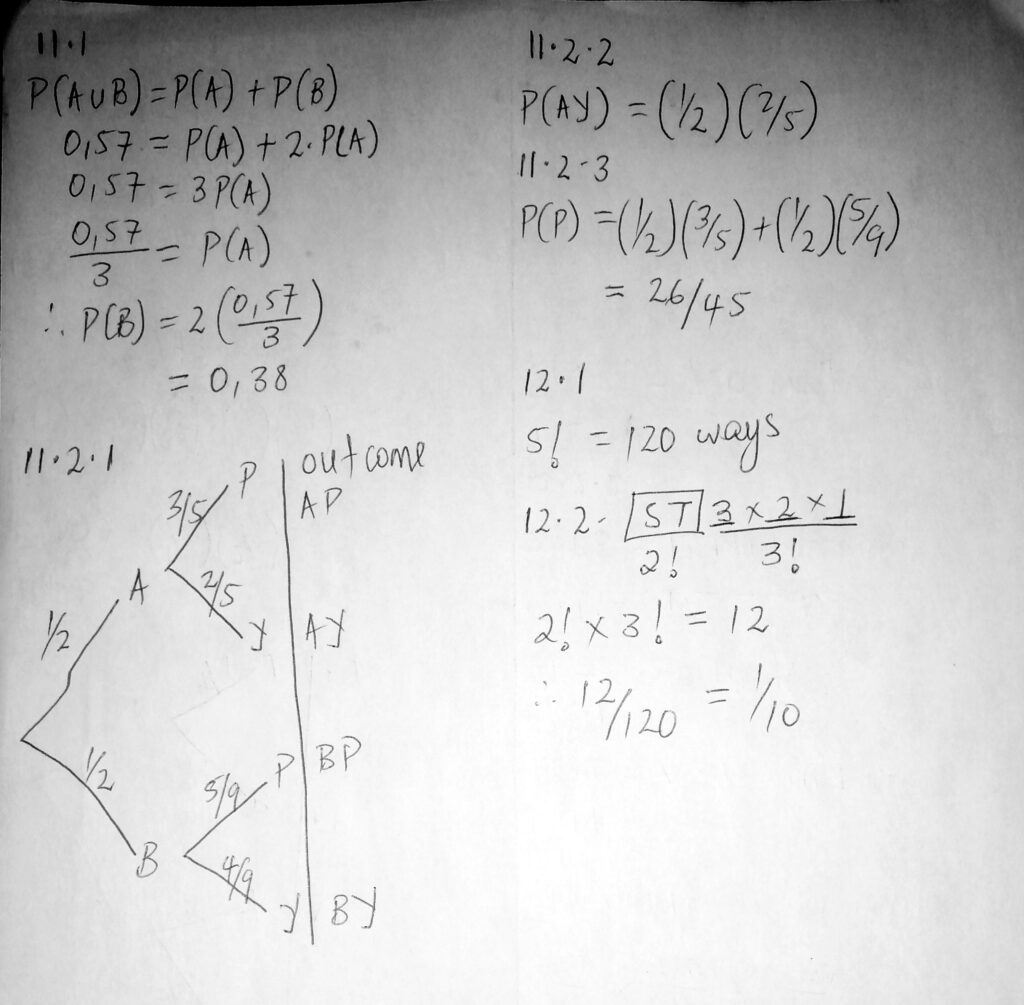
11.1
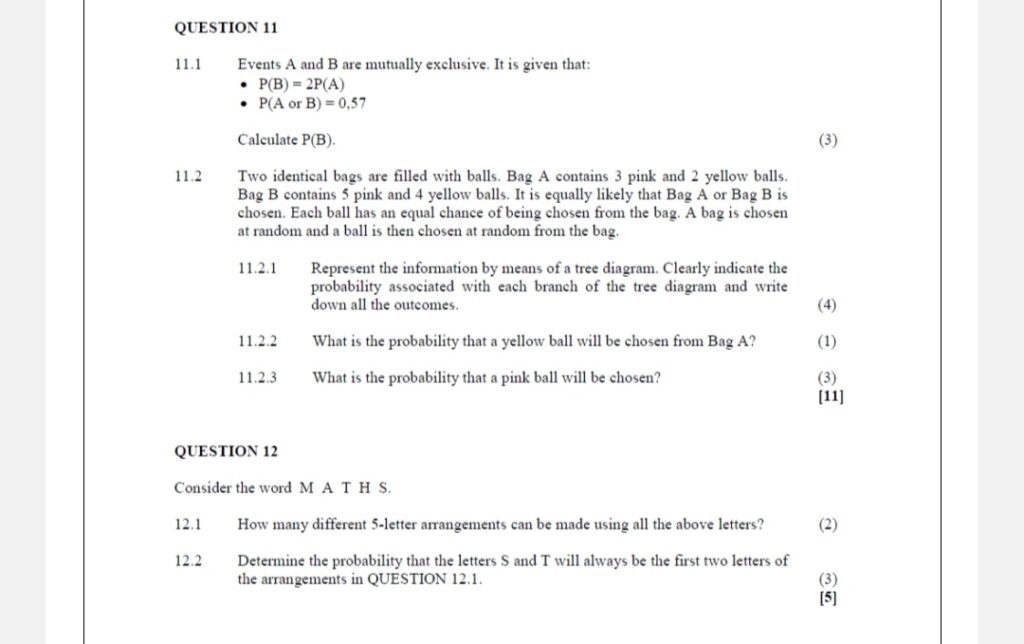
Event A and B are mutual exclusive events
- This means they cannot occur at the same time
- The probability of the intersection, P(AnB), is zero
We’re further given properties we can use on the addition rule to provide an answer
- P(AuB)=P(A)+P(B)-P(AnB)
- But in this case the probability of event A and B occurring together is zero
- Therefore, the addition rule will be reduced to P(AuB)=P(A)+P(B)
- From here we can replace the given information and solve for probability of B as in the answer sheet bellow
11.2.1
Representing information, a tree diagram is tricky but simple, first time I did this I even drew it wrong.
The trick is to pay attention and place yourself in that situation, imagine you are there actually picking the pink and yellow ball from bag A or B
- It is given that we have two bags with equal probability, that is ½
- We can pic from bag A or B
- Myself I initially drew as if we are picking simultaneously, but the case is, we are picking from either bag, hence the ½ probability on our first two branches
- Bag A has a total of 5 balls, 3/5 pink and 2/5 yellow
- Bag B has 9 balls, 5/9 pink and 4/9 yellow
- The above two points make up our second branches as in the answer sheet
- Do not forget the most important part, the outcome
To identify probability using the outcome column
- Multiply probabilities across the branches
- And add the probabilities downwards on outcome
11.2.2
A yellow ball picked from bag A is A and Yellow, AY in our outcome
So, we multiply the probability of branch A and that of branch B
11.2.3
The probability of Pink is anywhere in our outcome where there is pink, P
That is, BP and AP
Multiply across the branches and add downwards
12.1
Given the word MATHS
We use factorial to find number of ways we can possibly arrange these letters
! is used as a factorial sign, found on casio calculator just below mode button
_ _ _ _ _
The above are empty spaces we have to fill using the 5 letters from the word MATHS
On first space we have 5 letters we can chose from, on second we have 4 since we have used 1 already, and then we have 3 letters left, then 2 and lastly 1
5x4x3x2x1
This can be written as 5! ,we have 5! Ways to arrange these letters
12.2
If S and T are to start, we therefore have fixed positions and can only make a choice on the last three letters
But we are not restricted on moving S and T, we can start we S or T, making it 2 arrangements
And then the last 3 we can arrange in 3!
Since we are asked probability, we must express our answer over total possible arrangements found on the first question above.
Answer: